

Ana Rosa Gamarra is a PhD researcher at CIEMAT’s Energy Department working on the sustainability assessment of energy systems. Her expertise focuses on renewable energy technologies, applying several methodologies such as Life Cycle Assessment, Life Cycle Costing, Life Cycle Sustainability Assessment, environmental and socioeconomic EMRIO, as well as analysis of governance and dependence implications. She has participated in numerous national and European research projects.
Carmen Lago is a researcher at CIEMAT’s Energy Department with extensive experience in the environmental and sustainability assessment of energy systems. Her research focuses on renewable energy sustainability, Life Cycle Assessment (LCA) and greenhouse-gas emissions evaluation. She has participated in numerous national and European research projects addressing sustainable energy, bioenergy and low-carbon transition pathways.
How sustainability assessment methodologies help SOLARIS identify PV O&M solutions that create environmental and economic value over a solar plant’s full lifetime.
Solar power is a central part of Europe’s clean-energy transition. Photovoltaic (PV) plants generate electricity without fuel combustion during operation, but their sustainability does not end when panels are installed. A solar plant needs to perform reliably for decades. Dust and soiling, damaged cables, inverter faults, weather exposure, component ageing or unnoticed losses in performance can reduce the electricity delivered to the grid. If issues are detected late, they can lead to unnecessary downtime, lost renewable generation, urgent maintenance visits and premature component replacement. This is why operation and maintenance, usually known as O&M,matters. The Horizon Europe SOLARIS project is developing and demonstrating tools to support smarter PV operation and maintenance.
An important question: smarter, but sustainable?
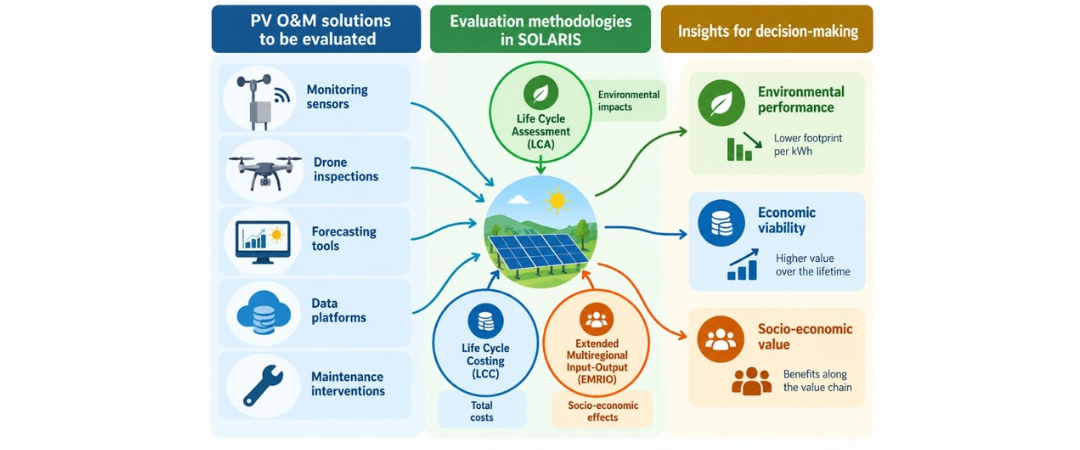
Digitalisation offers major opportunities for solar energy. Sensors can track operating conditions. Drones can inspect large areas. Forecasting tools can help operators anticipate risks. Data platforms can bring together information from different parts of a plant and support faster, more targeted action. However, new technology is not automatically sustainable simply because it is innovative. A sensor requires materials, manufacturing, installation and electricity consumption. A drone inspection requires equipment, energy and trained personnel. A digital platform requires hardware, connectivity, data processing and associated energy consumption. Maintenance itself may involve travel, labour, spare parts, cleaning water and waste management.
The key question is therefore not only whether a solution improves technical performance. It is whether the benefits it creates outweigh the environmental burdens and costs associated with deploying it.
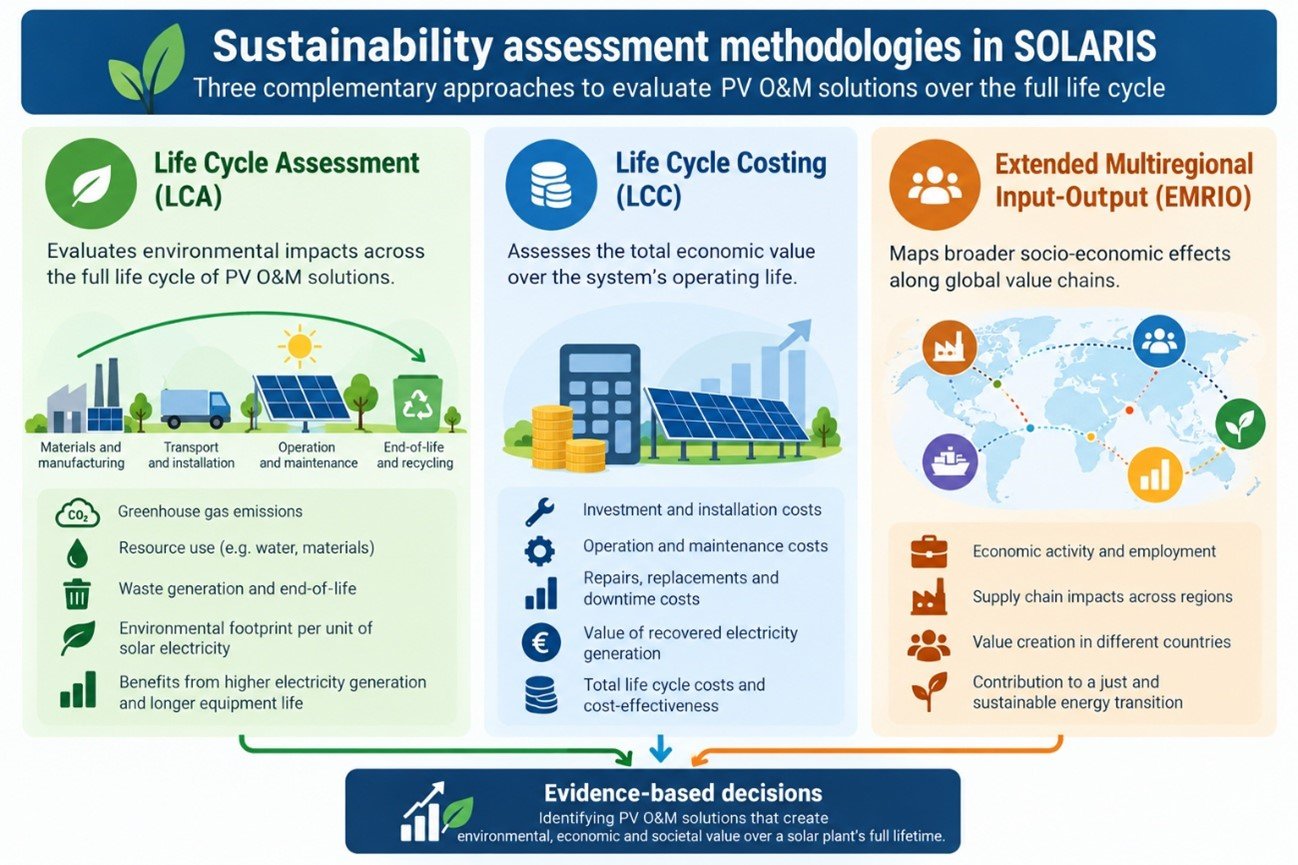
In SOLARIS, this question is addressed through three complementary methods: Life Cycle Assessment (LCA), Life Cycle Costing (LCC) and Extended Multirregional Input-Output (EMRIO).
Looking beyond the installation phase
Life Cycle Assessment examines environmental impacts across the full lifetime of a product, technology or system. In the case of PV O&M, this means looking beyond the solar panels themselves.
An LCA can account for the environmental footprint of monitoring equipment, inspection tools, transport, electricity consumption, cleaning activities, spare parts and the treatment of replaced components. At the same time, it can assess potential benefits, such as higher electricity generation, fewer maintenance visits, avoided failures and a longer useful life for PV equipment.
This full-life-cycle perspective matters because the use phase of a solar plant is not impact-free. Maintenance activities are essential for sustained performance, yet they also use resources. Recent research on PV maintenance highlights the importance of considering site-specific factors such as water use, local conditions and the characteristics of maintenance interventions when assessing environmental performance.
In simple terms, LCA helps answer: Does a smarter O&M strategy reduce the environmental footprint per unit of solar electricity delivered over the plant’s lifetime?
Measuring the costs that matter over time
Life Cycle Costing complements LCA by examining the economic side of the same decision. The purchase price of a new monitoring device or inspection service is only one part of the picture. The total lifetime cost of PV operation can also include installation, data management, inspections, labour, repairs, component replacements, plant downtime and the value of electricity that is not generated when a fault remains unresolved.
LCC helps compare these costs over time. For example, a tool that requires an initial investment may still be worthwhile if it reduces repeated site visits, prevents a major failure, avoids the early replacement of an inverter or recovers electricity that would otherwise have been lost.
This does not mean that every digital solution will be cost-effective everywhere. A large utility-scale solar plant may benefit substantially from automated monitoring or drone-based inspections, while a smaller rooftop system may require a simpler approach. The economic result depends on several factors to be assessed, such as plant size, accessibility, local labour costs, etc.
LCC therefore helps answer a second essential question: Does the O&M solution deliver better value across the system’s full operating life?
Mapping the Socio-Economic Value Chain of Smarter PV Maintenance
To complement environmental and cost assessments, SOLARIS also examines the wider socio-economic effects of its PV O&M solutions through an extended multi-regional input–output (EMRIO) approach.
EMRIO analysis traces the goods and services required along the value chain, from the manufacture of sensors, drones, electronic equipment and spare parts, to software and data services, transport, maintenance activities and end-of-life treatment, and links these activities to the total global economic output, value added and employment across countries and sectors.
This perspective is particularly relevant for digital O&M solutions: while they may reduce plant downtime, material use and unnecessary field interventions, they can also shift demand towards direct and indirect sectors and countries more intense in the production of electronics, ICT infrastructure and specialised services. By comparing a baseline O&M strategy with SOLARIS-enabled alternatives, EMRIO can identify where socio-economic benefits (job and value-added creation) occur, helping ensure that improved PV performance is accompanied by a more transparent and responsible value chain. In other words, EMRIO can help to answer how much SOLARIS solutions can create employment and value added, and how is the geographical distribution of socio-economic benefits across European and global value chains?
Particularities of Sustainability Assessment of O&M of PV in Solaris
Avoiding impacts, not only detecting faults
The value of smarter PV maintenance lies in the actions it enables. If a monitoring system detects underperformance early, operators may be able to investigate the cause before it develops into a serious failure. If data help distinguish between a temporary issue and a genuine fault, unnecessary maintenance trips may be avoided. If an inspection identifies a problem in time, a component may be repaired rather than replaced.
These are examples of what can be called avoided burdens: environmental impacts and costs that do not occur because maintenance becomes more targeted, timely and effective. Of course, these benefits need to be demonstrated and quantified rather than assumed.
One solution does not fit every solar plant
For this reason, SOLARIS is validating its innovations in eight demonstration use cases across Europe, covering different PV configurations and operating environments. This real-world testing is essential. It makes it possible to evaluate not only whether a technology works, but also under which conditions it provides the greatest environmental and economic benefits.
The assessment must consider the whole context: local climate, maintenance practices, component reliability, accessibility, electricity production, use of resources and plant lifetime. LCA and LCC provide a structured way to combine these considerations.
From data to better decisions for a more sustainable solar future
The role of data in SOLARIS is not simply to collect more information. It is to support better decisions. The success of the solutions should ultimately be judged by whether they help produce more solar electricity with fewer resources and lower lifetime costs, with favourable value chain impacts.
This is where the combined use of LCA/LCC and EMRIO becomes especially valuable. LCA highlights environmental trade-offs. LCC identifies economic implications, and EMRIO evaluates the socio-economic impacts across the world. Together, they help avoid decisions based solely on short-term cost, technical novelty or a single environmental indicator.
Europe needs a rapid expansion of solar energy, but it also needs solar assets that can operate efficiently, reliably and responsibly over the long term.
The solar plant of the future will not only convert sunlight into electricity. It will also use information intelligently, directing maintenance where it is most needed and extending the value of the equipment already installed. SOLARIS is contributing to this transition by bringing together advanced O&M technologies with a robust assessment of their environmental and socioeconomic implications. The project’s ambition is clear: make PV operation smarter while ensuring that smarter operation also supports sustainability.
 French