

Dr. Tadeja Veršič Deshmukh holds a PhD in Astrophysics and is an expert in machine learning, statistical modelling, and advanced data analysis of complex physical systems. At UBIMET GmbH, she works as a Meteorological Data Scientist in Energy Meteorology, developing advanced machine learning and physics-based models to improve wind and solar power production forecasts.
Verena Ruedl, MSc holds a Master’s degree in Industrial Engineering, specializing in AI and deep learning applications for production systems. She leads the Innovation Management team at UBIMET GmbH, coordinating R&D activities across the UBIMET Group. Over the past two years, she has successfully led numerous national and international research projects, with a particular focus on renewable energy.
As solar energy becomes a central pillar of modern energy systems, accurately predicting photovoltaic (PV) power generation is becoming increasingly important. Grid operators, energy traders, and plant operators rely on precise forecasts to balance supply and demand, maintain grid stability, and optimize energy markets.
Within the SOLARIS project, UBIMET explored new approaches to improve solar power forecasting. By combining physical models, machine learning, and deep learning techniques, the project developed a hybrid forecasting framework capable of delivering more accurate short-term predictions.
A particular focus was placed on integrating live operational data from PV systems into the forecasting process. Among the tested approaches, deep learning with Long Short-Term Memory (LSTM) networks showed especially promising results.
From Physical Models to Hybrid Forecasting
Solar power forecasting traditionally starts with physical models that translate meteorological inputs into expected PV power output. These models rely on known relationships between solar irradiance, temperature, wind conditions, and PV system characteristics.
Within the SOLARIS framework, such a physical model served as the baseline forecasting system. Physical models offer several important advantages. They are computationally efficient, robust and capable of generating forecasts even when no historical operational data is available. This makes them particularly valuable for newly installed PV systems or sites where long-term monitoring data does not yet exist.
However, real-world PV systems are influenced by many additional factors that are difficult to capture using purely physical models. Local microclimates, temporary shading effects, site-specific performance characteristics and operational changes over time can all affect power production. These influences introduce nonlinear behaviour that deterministic models alone cannot fully represent.
To address these challenges, UBIMET developed hybrid forecasting approaches within the SOLARIS project that combine physical models with machine learning techniques. In this framework, the physical model provides a baseline forecast, while the machine learning component learns systematic forecast errors and complex nonlinear relationships from historical data.
Why Integrating Live Data Matters
An important challenge in solar forecasting is the integration of real-time observations from PV plants. Weather forecasts and physical models provide valuable information, but they cannot always capture sudden changes in solar production caused by rapidly evolving atmospheric conditions such as moving cloud fields or morning fog.
To improve forecast accuracy under such circumstances, UBIMET investigated different methods for integrating live measurements into the forecasting process within the SOLARIS project. One approach relied on a Kalman Filter, a widely used statistical technique that dynamically corrects forecasts by learning from recent errors. In the SOLARIS implementation, the filter continuously evaluates deviations between forecasts and observations during the previous hours and adjusts upcoming predictions accordingly.
While this approach improves short-term accuracy, testing revealed an important limitation. Because the Kalman Filter relies strongly on the most recent observations, it sometimes reacts too slowly to sudden changes in solar production. Such, Kalman Filter corrected forecast can therefore show delayed peaks or troughs and overforecasting in the evening rather than anticipating upcoming developments.
To address this limitation, the UBIMET research team explored a deep learning approach based on Long Short-Term Memory networks. LSTM is a specialised form of recurrent neural network designed to analyse sequential data such as time series. Unlike conventional neural networks, LSTM models can learn long-term dependencies while avoiding the vanishing gradient problem that affects standard recurrent architectures.
This capability is particularly valuable for solar forecasting because PV generation follows several time-dependent patterns. Daily solar cycles, evolving weather systems, persistent cloud structures and seasonal effects all influence PV power output. By learning these temporal relationships directly from historical data, LSTM models can identify patterns that are difficult to represent explicitly in physical models.
The LSTM model developed within SOLARIS was trained using historical PV production data from the SOLARIS demonstration site at the Technical University of Denmark (DTU) together with meteorological forecast parameters from numerical weather prediction models. During development, only historical observations were available, so these data were treated as simulated live measurements during testing. Once trained, the model generates forecasts for short lead times between fifteen minutes and four hours, which are particularly relevant for applications such as grid balancing, intraday electricity trading and short-term plant operation planning.
Comparing LSTM and Kalman Filter Performance
The performance of both models is first assessed using a quantitative evaluation based on the Root Mean Squared Error (RMSE) metric. The results indicate that the LSTM model consistently improves forecast accuracy across a wide range of forecast lead times compared with the Kalman Filter approach.
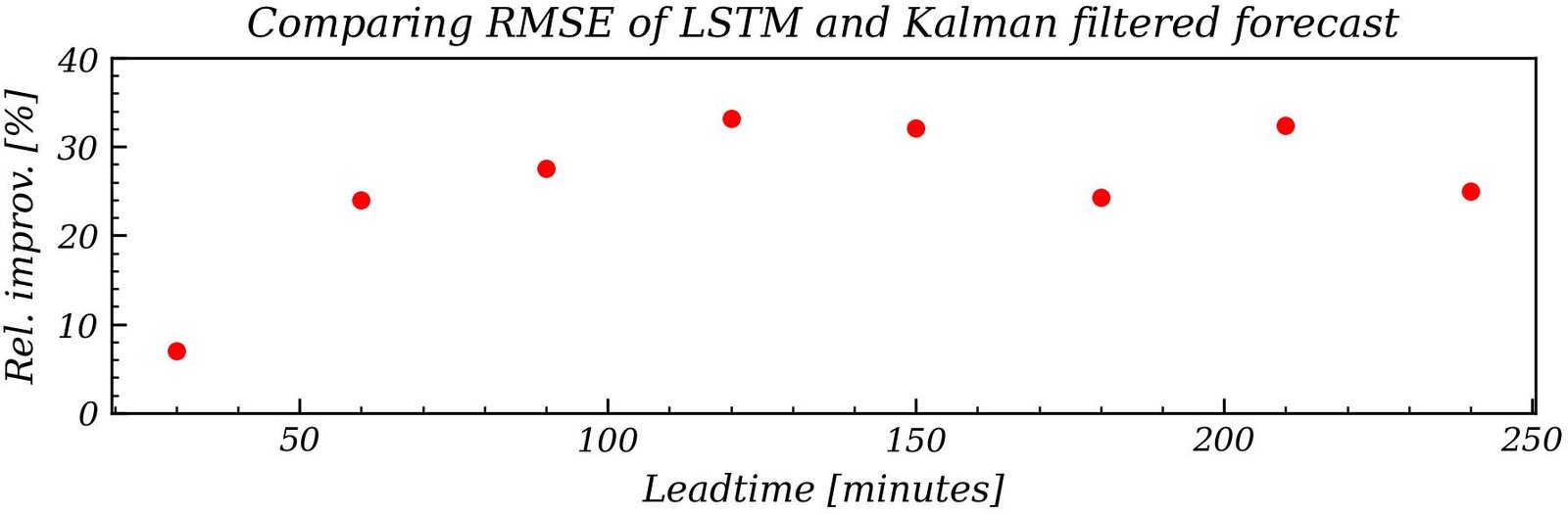
Figure 1: Relative RMSE improvement of LSTM compared to Kalman Filter for the different lead times
Across most lead times, the LSTM model achieves a relative improvement of approximately 20% to 35% relative to the Kalman Filter. This clearly demonstrates the model’s ability to capture complex temporal dependencies and correct systematic forecast errors that the Kalman Filter cannot fully address. Another important observation is the difference in performance as forecast lead times increase. While the Kalman Filter shows a noticeable decline in accuracy for longer horizons, reflecting its reliance on the most recent observations, the LSTM model maintains a comparatively stable performance. This stability highlights LSTM’s capability to learn both short-term fluctuations and longer-term patterns in PV generation, making it particularly suitable for applications that require reliable forecasts across multiple time scales.
The reasons for these differences become clearer when analysing the temporal behaviour of the forecasts for a 30-minute lead time. The observed PV power output is shown in blue, the Kalman Filter forecast in green and the LSTM prediction in black.
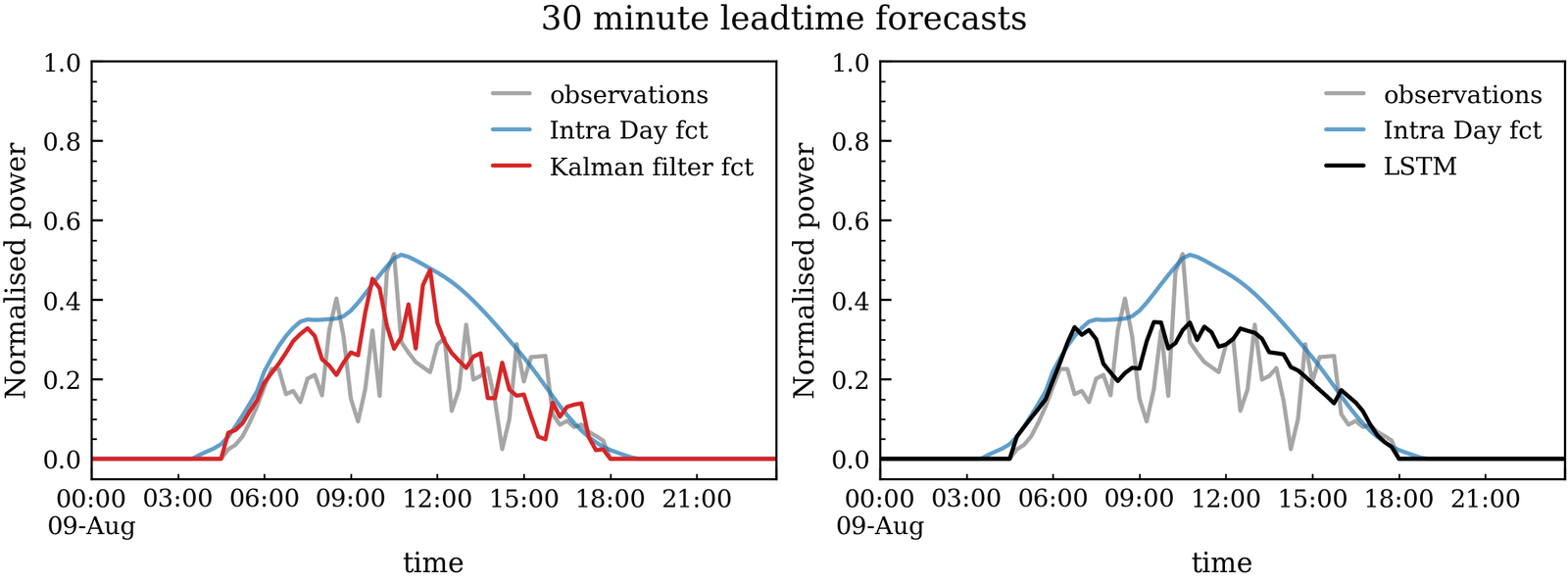
Figure 2: 30-minute lead time forecasts comparing observations, Kalman Filter (red line) and LSTM predictions (black line)
Both Kalman Filter and LSTM forecast improve the forecast performance when compared to the physical intraday forecast. As shown in Figure 2, the Kalman Filter in red on the left panel and LSTM in black on the right panel better represent the observations in grey than the intraday forecast in blue. The Kalman filtered forecast shows prominent delayed peaks and troughs, while the LSTM more closely represents the mean behaviour of the observations and improves the intraday forecast.
The Future of Solar Power Forecasting
The results of the SOLARIS project highlight the strong potential of deep learning methods for improving solar power forecasting. Methods like LSTM require significantly less training data and computationally resources than other more complex deep learning methods. By combining the strengths of physical modelling, machine learning and deep learning, hybrid forecasting systems can produce more accurate and more reliable predictions of PV power generation.
Physical models provide a robust baseline based on meteorology and system characteristics. Machine learning models correct systematic errors, while deep learning approaches such as LSTM enable effective integration of real-time observations and complex temporal patterns.
As solar generation continues to grow worldwide, forecasting tools that combine these complementary approaches will become increasingly important. More accurate predictions not only improve operational planning for PV plants but also support the stability and efficiency of the entire energy system, helping to accelerate the transition toward renewable energy.
 French