
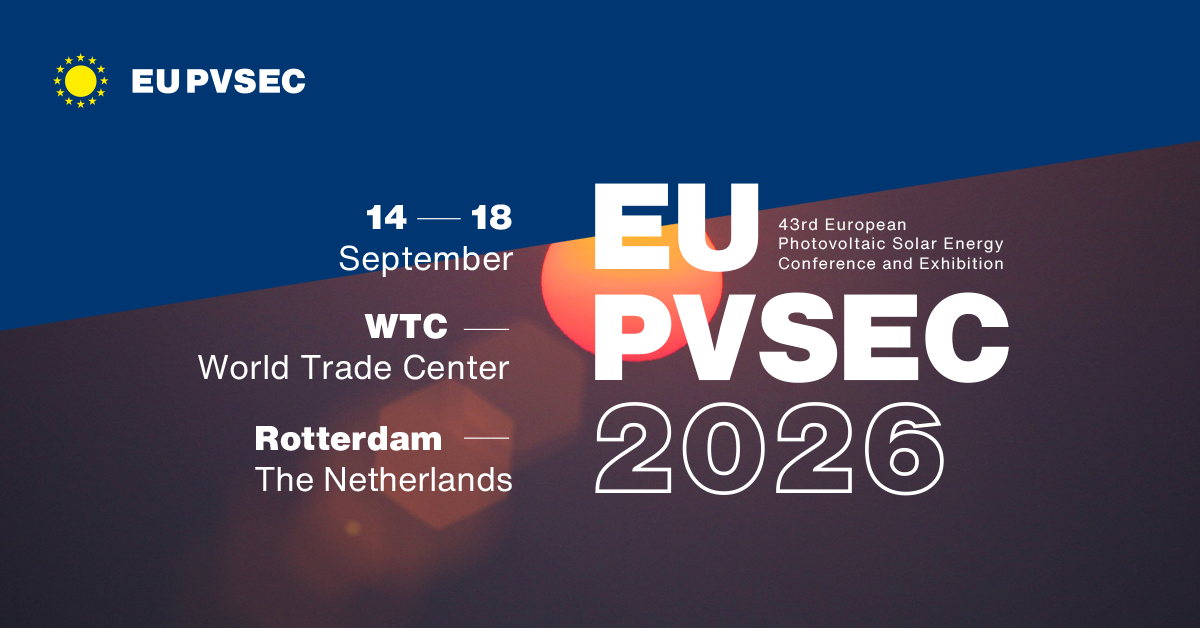
Together with our sister projects, PVOP and SUPERNOVA, Solaris will participate at EU PVSEC and organise a parallel event during the conference.
Make sure to join us on September 15 at 15:15!
The event brings together three Horizon Europe projects to present a shared vision for next-generation PV plants in the Terawatt era. The session follows the digital and operational value chain, from field-level monitoring hardware to software tools and data integration. The hardware part will address improved plant observability through innovative low-cost sensing concepts presented by Tekniker/SOLARIS. The software part will address advanced plant operation through solar tracker control software for undulating terrain by UPM/PVOP. The data management part will present the SUPERNOVA PV Data Space as a secure and sovereign infrastructure for data exchange across the PV sector. Through short inputs and audience interaction, the event will show how European R&I is enabling PV plants that are more observable, digitally integrated and efficient to operate.
The PV Plant of 2035: From Design to Daily Operation – 15.09.2026 15:1-16:45 – Auditorium 5
Improved Plant Observability through Innovative Low-Cost Sensing Concepts
Speaker: Mr. Joseba Izaguirre (Tekniker) | Solaris project
Current solutions for continuous, real-time observation and massive monitoring of relevant parameters for PV plant operation such as mechanical integrity of PV modules, or efficiency loss due to dust accumulation, usually require offline or manually operated discrete measurements, or the deployment of unaffordable and/or not fully reliable technologies. This presentation will provide examples of easy-to-deploy low cost sensing concepts proposed and developed under SOLARIS EU-funded project and how those solutions support the development of novel management approaches to improve O&M strategies in combination with current plant operational data.
Improved Plant Observability through Innovative Low-Cost Sensing Concepts
Speaker: Mr. Javier R. Ledesma (Universidad Politécnica de Madrid, Madrid, Spain) | PVOP
PV plant managers and operators grapple with a range of challenges, including subpar energy production, ineffective solar tracker algorithms, undetected performance losses, overwhelming data and alarms, while declining electricity prices are putting downward pressure on O&M costs. In this presentation we will provide details and results on the gain in terms of effective irradiation, electricity production and economic income of a new control algorithm for solar trackers for PV plants in complex terrains, with special attention to the backtracking period.
Data Spaces for the PV Plant of the Future: Enabling Secure and Sovereign Data Exchange
Speaker: Mr.Corentin Tissier (CSEM – Centre Suisse d’Électronique et de Microtechnique SA) | Supernova project
Modern PV plants generate vast operational data, but much stays siloed, limiting cross-fleet benchmarking, analytics, and AI-driven services. This presentation introduces the SUPERNOVA PV data space, a decentralized infrastructure from the EU-funded SUPERNOVA project enabling asset owners, O&M providers, researchers, and service providers to exchange data while retaining full sovereignty over what they share, with whom, and why. Built on the IDSA reference architecture and aligned with FAIR principles, it offers a standardized, trust-based environment for the solar sector. We present the architecture, development status, and early connector deployment results, plus an outlook toward the digital PV plant of 2035 — and invite stakeholders to join as early adopters.
Electroluminescence Inspection of PV Plants by Drone: Toward Scalable Digital Diagnostics
Speaker: Dr. Sergiu V. Spataru (DTU – Technical University of Denmark) | Solaris project
This presentation introduces drone-based electroluminescence inspection as a scalable diagnostic method for future PV plant operation. Results from a Horizon Europe project are used to illustrate both nighttime and daytime EL inspection approaches, including image acquisition, preprocessing, correction, and analysis pipelines. The presentation compares the practical role of high-quality nighttime EL imaging with more challenging daytime EL measurements, highlighting how both can contribute to module- and plant-level diagnostics. Finally, the work is connected to a digital workflow for importing inspection datasets, processing diagnostic images, correcting module views, extracting analysis results, and supporting consistent diagnosis of PV module faults across inspection conditions.
 French